Monday, February 25, 2013

Scenery and Place

I've been able to drive back and forth between middle and east Tennessee several times in the last three weeks. The color palette is more diverse than you might expect. In the distance sometimes you can see that certain trees have the reddish early spring cast as they begin to bud out.


I believe the introduction of the American interstate system probably sealed the deal on landscape as commodity. The scenery became something behind glass that we consume at high speeds. The difference between the macro view of vistas and rolling hills unfolding out from I-40 and the ecological minutiae of place is one that I hope the Land Scouts can help span. This is not to say that we must walk the distances we drive (although it's not a bad idea if you've got the time, wits, and health to do so), but that our understanding of the large scale scene is deepened in a significant way when we have personal experience with the specific and individual. I suspect this rule would hold true for other situations. For example, how we view populations of people.

Glitch art and a landscape: technology gets organic.
How can we create relatively convenient and meaningful land experiences that provide the familiarity and intimacy needed to become good stewards? How can we make those experiences accessible to as many people as would like them? Things on which to stew in the coming weeks as we hope for Spring and notice the days lengthening.

Tuesday, January 29, 2013

Step Out

Unseasonably warm and then icy and cold. Nashville is not so different from Knoxville and many other parts of the southeast in that spring plants emerge during warm spells and are then blasted back. Pictured below are various plants and sites in winter dormancy. This time of year is for walking, seeing, locating, noting, and planning.

Dark colored bamboo!

Future pumpkin patch in the alley.

Sweetgum tree and telephone line pole.

Thursday, January 3, 2013

Landward, ho!

Two medium-sized changes over at Land Scout central.
1.We're relocating to Nashville, TN.
2. I'm adjusting the name of the project and occasionally dropping the "urban" from the land scouts.

There are two reasons behind the second change.
a) The cadence of Land Scouts is nicer.
b) The shorter name allows for place-specific iterations like the Nashville Land Scouts, the Chicago Land Scouts, the Your-Neighborhood-Here Land Scouts while keeping the various groups under the larger heading of the Urban Land Scouts.

Look forward to more Land Scouting coming out of Middle Tennessee. Thanks to the many wonderful scouts and stewards in East Tennessee who've helped test out, refine, and embody the Land Scouts to date.

Happy 2013 to all!

Tuesday, November 27, 2012

Fritz Haeg Interview

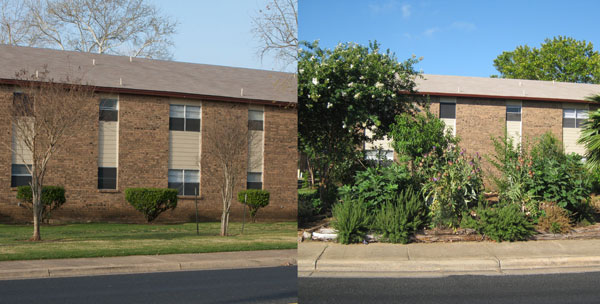
 Image credit: Edible Estates Regional Prototype Garden #5, Austin, Texas. Commissioned by Arthouse. Image
    credit: Fritz Haeg

This is a nice interview from the American Society of Landscape Architects with Fritz Haeg, the artist behind Edible Estates: Attack on the Front Lawn. I love his frankness about the outcomes of urban gardening and his reasoning for working with single families. His projects "...operat[e] at the cellular level of one family, one individual. Because that's viral, it can spread, anyone can do it, and that's powerful." He goes on to talk about the less quantifiable benefits of small scale gardening (or urban farming) saying, "For me, it comes down to pleasure and I think that's the best point of entry into big cultural shifts like this."

Amen, to that brother. The Urban Land Scouts are, I hope, a pleasurable point of entry into a shift in awareness about our immediate land. Let's hold off on trying to use urban agriculture in the same way that we use large scale agriculture and focus on the aesthetic, cultural, and peripheral benefits from the material, scale, and pace of this work. 

A final shout out and source: I found this article on the facebook page for Urban Edge Studio. Thanks very much to Angelike Angelopoulos for directing me to their work!


Thursday, November 8, 2012

Our History is Preserved in Every Seeds - Fiona McAnally


I'm pleased to say I know Fiona McAnally and sure her talk will be a good one. Hodges is the large ziggurat-like brick library on UT's campus. This fine flyer was drawn by Elias Attea.

Tuesday, November 6, 2012

This is How We Learn

Several years ago a friend gave me some native sunchokes (Helianthus tuberosus) from his yard and warned me, "They'll take over." I nodded but thought to myself, "I'll keep them in check. They won't take over in my yard." 

There is an adage in planting: right plant, right place. In the case of sunchokes (also known as Jerusalem Artichokes), the right place is a large sunny field or side of the road where you're not planning to grow other perennials. While I thought I kept the sunchokes somewhat in check by only letting a handful of plants grow each year, I was naive in thinking of the plant in terms of what was visible above ground. 

Tuber harvest

The plants have spread their tubers throughout the small bed in front of our house. I was excited to harvest some...until I realized how pervasive they were. These plants will outlast and outcompete my time and attention. And this is how we learn.


Wednesday, October 31, 2012

Relief


Seeds of Change will donate $1 to the American Red Cross for every packet of seeds purchased between now and November 15th.